Fabric and edging for a gravel front garden
A front garden that was a lawn can be laid to gravel and needs far less upkeep than grass, with no mowing and no watering. Stone of this size stays put in a wind better than sand or fine gravel, which matters at the front of a house that takes a lot of weather. The job is a layer of shingle on a sheet of fabric, held in by edging. This guide works through a bed 4.8 metres by 3.2 metres, 50 millimetres deep, and counts the shingle, fabric and edging it takes.
Herne Bay BM is the Herne Bay delivery site of Discount Builders Merchants (KENT) LTD, the builders' merchant at Lower Road, Northfleet, DA11 9BB. There is one yard, and orders are placed on www.discountbm.co.uk.

Clear the ground and check the fall
Strip the turf and the topsoil down to a firm base, and take out any roots that would push the fabric up later. Look at where the rainwater goes. A front garden that slopes towards the house sends water to the wall, so the surface should fall gently away from the building. Keep the gravel clear of any air brick or vent at the foot of the wall, since a blocked vent holds damp in the house.
Compact the ground by treading it or with a light plate, then rake it level. A soft patch left in the bed sinks under the stone within a season and shows as a dip in the surface. Fill any hollow with firm soil and tamp it before the fabric goes down, not after.
Laying the fabric
Lay a geotextile fabric across the whole bed, turned up a little at each edge where the edging will stand. Its job is to stop soil rising into the stone and stone sinking into the soil, and it lets water pass through. Overlap any two sheets generously, and pin the fabric at the edges so that the wind does not lift it before the stone is on.
Cut the fabric round any plant or pipe rather than laying it over the top, and mark the line of the edging before the stone goes down. A sheet that is not cut to fit a corner bunches up, and the stone then lies unevenly over the bunch. A few minutes at each corner saves a patch of thin gravel later.
Edging the bed
Edging holds the stone in the bed. Flat-topped edging, pinned with steel pegs along the outer edge, keeps the shingle from spreading onto the path or the lawn next door. Set the top of the edging level with the finished surface of the stone, not with the soil underneath, so that rain does not wash the stone over the top.
Run the edging along the three sides that are not against the wall, and leave the side by the house open for the drain. Butt the lengths together so the line is continuous, and allow a few millimetres at the joints for movement. A peg at each joint holds the lengths in line, and a peg at the end of each run stops it lifting in a wind.
Choosing and spreading the shingle
Shingle at 20 millimetres is the stone for a surface. It is rounded, which is kinder underfoot and to the fabric than broken stone, and it does not pack hard. The 10 millimetre size is finer and packs tighter, which suits a path that is walked on every day rather than a bed to look at.
Spread the stone to the depth in the design, which for a garden surface is around 50 millimetres. Empty the bulk bag in small heaps across the bed, then rake them out evenly. A heap spread too thin leaves bare fabric at its edge, and that is the first place a weed gets through.
Looking after the surface
A new gravel bed needs little once it has settled. Rake it over once or twice in the spring, and top up any thin patch from a spare bag, since a bag of the same stone matches the colour of what is already there. Weeds that come through the fabric are best pulled by hand while the soil is damp, rather than hoed across the top, which tears the fabric.
Keep any spare stone under cover until it is spread, and stand the bulk bag on firm ground where it can be lifted without sinking. A bag left on soft soil for a week sinks at one corner, and a bag that has sunk is hard to lift back off the ground without a machine.
Rules of thumb
| Stone depth | 50 mm for a garden surface. Multiply the area in square metres by 0.05 to get cubic metres. |
|---|---|
| Shingle weight | About 1.6 tonnes to the cubic metre loose, so a bulk bag of about 0.8 tonnes covers roughly half a cubic metre. |
| Fabric | A roll covers about 50 square metres. Allow for the turn-up at each edge and any overlap. |
| Edging | Each piece is 914 mm long. Count 1.1 pieces to each metre of edge. |
| Bed area | Length times width in metres. The edging runs only along the sides that are not against the wall. |
The shop has calculators that turn a measurement into a quantity.
On the shop today
The products this guide talks about, from the shop's Aggregates aisle. Prices last checked .
-
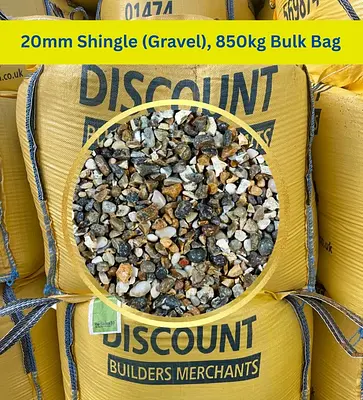 Bulk 20mm Shingle
each
£67.50 inc VAT
£56.25 ex VAT
In the yard
Prices are the shop's prices today. Stock and ordering are on www.discountbm.co.uk.
Shingle, sand and ballast for CT6 gardens See all Aggregates on the shop
Delivery to Herne Bay
- CT6
-
Ask the yard about this district. It is not a shop price.
More guides for Herne Bay
- Rebuilding a brick front garden wall Matching yellow brick for a low front garden wall in CT6: the old wall, the footing and damp course, the coping, and a worked order collected from the yard.
- A garden store in blockwork on a base Blockwork walls for a small garden store in CT6: the concrete base and sub-base, the door lintel and damp course, and a worked order collected.
- Rafters and decking for a porch roof Rafters, wall plate, fascia and OSB decking for a small lean-to porch in CT6, with the fall and the salt wind in mind, and a worked order collected.